
Blue Collar Worker Over 10 Million Strong
Our Forgotten Heroes
Blue Collar Worker
Blue Collar Worker Over 10 Million Strong are Our Forgotten Heroes. First, what exactly is a Blue Collar Worker? When googled, their AI Overview bot puts it this way: “A blue-collar worker is a person who performs manual labor or works in a skilled trade, such as a mechanic, plumber, or construction worker. These jobs are often physical and hands-on, frequently involving working outdoors or with heavy machinery in sectors like manufacturing, construction, and maintenance. While many require specialized skills and training, they are traditionally paid hourly wages rather than a fixed salary”
The 2024 guesstimate from data collected puts this number at over 10 million workers in Canada alone. Trades, transport and equipment operators and related occupations: To be honest, I would also include retail staff, warehousing, even administrational workers and teachers. Basically anybody who makes under 6 figures annually.
This major group had over 4 million Canadians in the trades as of a 2024 report, with about 700,000 expected to retire by the end of the decade. Construction: Employment in this industry was approximately 1.5 million in March 2024, though it experienced some monthly declines throughout the year. Transportation and warehousing: This sector employed around 767,654 people in late 2024. Manufacturing: This industry had approximately 490,000 job openings in April 2024, indicating a significant workforce size. (info)
But are they Our Forgotten Heroes? Yes, they are. A fact that the population and powers to be haven’t truly realized. Have you ever asked yourself what workers go through on a daily basis. Let’s go to one worst case scenario that I can think of as winter approaches. A huge winter ice storm hit the area you reside in. Rolling in like a herd of buffalo the weather drops to -20oC with winds steady at 25 km/h.
Next the freezing rain starts with a windchill factor settling at -31oC. The final nail in the coffin is within 12 to 24 hours electrical lines start to snap from ice buildup and your power goes out. Ever stop and really think about how your power just reinitialized all of a sudden, and who does it?
Our Forgotten Heroes
Lineman
Lineman, that’s the trade of professionals who brave the freezing weather so once again you may enjoy all your creature comforts. The Risks and Hazards a lineman has to face are incredible.
- Electric shock, Burns, Arc flashes/blasts, and Electrocution,

Our Forgotten Heroes, Lineman
- Falls from heights,
- Extreme temperatures and Inclement weather,
- Toxic substances causing Respiratory ailments,
- Motor vehicle accidents and Equipment malfunction,
- Animal attacks and Fires

Any one of which from the aforementioned list has the potential of causing a fatality. Just one of many Blue Collar Workers
Jobs with the Highest Fatalities
The top 4 most blue-collar jobs in Canada with the highest fatalities per 100,000 workers. (info)
Fishing and Trapping
- Hazards: drowning, severe weather conditions, heavy equipment on unstable platforms. fatality rate (approx. 52 / 100,000 workers),
Mining, Quarrying, and Oil & Gas
- Hazards: cave-ins, explosions, gas leaks (H2S), other underground hazards, risks associated with offshore drilling and heavy machinery operation (approx. 47 / 100,000 workers)
Logging and Forestry
- Hazards: falling trees, operating chainsaws and skidders, working in rugged or remote natural environments (approx. 33 / 100,000 workers).
Construction (especially Roofers, Structural Iron, and Steel Workers)
- Hazards: so many but here are the most common. falls from elevation, being struck by objects, and electrocution. (approx. 20 /100,000 workers).
Worker Fatalities
On November 3rd, 2025 I started a conversation with the online Google AI bot. I wanted to calculate the number of Worker Fatalities from the Blue Collar Worker pool. I asked for this total amount for the years between 1900 and 2020. It was some undertaking to calculate this number. A Link to a 31-page Pdf document that’s a record of this conversation and premise of the calculations will be provided at the end of this article. A lot of factors and calculations needed to be figured out as the conversation progressed.
Some may disagree with the way I determined the number of work-related fatalities for these 121 years. However, I’m just a safety professional who once worked in the trades. I’m not a Mathematician or a Mathematical Statistician, and I figured I came up with a good formula to calculate this number. One extremely large hurdle to overcome was the complete lack of record keeping by any form of legislative authority throughout Canada for safety that can easily be accessible and published on the internet.
The Base Number
The base number I started with was derived by records that the Google AI Bot accessed from a study on the net and some other calculations (info). Between the years 1993 and 2024, approximately 31,438 worker deaths have been officially reported to and accepted by Canada's provincial and territorial workers' compensation boards (AWCBC data). With the help of the aforementioned Google AI Bot, it was also determined from an online CBC news article that was conducted from a study suggested that the worker tally of 31,438 should be 5 to 13 times higher. The number of 9 times higher was then used as an average for the calculation.
Another factor I believed was very relevant was Canadas population as a whole. The bot determined that between 1900 and 2020 Canadas population increased by 1 to 3 percent each year for the 121 years calculated. Therefor, it surmised that a percentage of 1.56 was appropriate to use as a perfect average.
The reason why I included the population growth is due to the size of the workforce. As the population of Canada grew throughout time, so did the needs of infrastructure, homes, energy needs and so on. That intern is a direct relation to the size of the countries workforce and the fatalities associated with their jobs. More people, more things needed, more workers employed, more accidents, more-more-more as time progressed forward.
Calculating Fatalities
Starting with 31,438 fatalities between 1993 and 2024. Added was the factor of 9 times this number (31, 438 × 9 = 282, 942). That number was then divided by 32 representing the number of years from 1993 to 2024 ( 282, 942 ÷ 32 years = 8, 842). Then I instructed the Google AI to do the following using the population increase of 1.56 % each year on average.
The Instruction
“Let's combine the two sets of number from each question: the 32 years between 1993 and 2020 we averaged 8,842 workers died from their jobs in Canada both reported and unreported. In regards to the second question: we averaged that the population of Canada grew on an average of 1.56% each year between those 120 years. With that, in the 120-year span between 1900 and 2020, take the average number of workers death of 8,842 per year and calculate the final number when multiplied by 120 years with a factor of 1.56% being deducted from the total for each year as we go back in time to the year 1900.
The Final Count
What the calculations came up with was overwhelming to say the least. Between the years of 1900 and 2020 an estimated number of workers who have died in Canada because of the occupation they were employed in is 3 5 9, 4 7 1. Now I may be off base here and completely wrong with my formula, and I sure hope I am, yet that number if I’m remotely in the neighborhood of being correct is unacceptable to say the least.
In Comparison
With all of that being said, one question has always haunted my mind and I cannot seem to find the answer. With the incomprehensible number of 359,471 work related deaths in 120 years, why isn’t the Blue Collar Worker celebrated more with honors and respect like others groups receive?
The Rainbow
With all due respect, the LGBTQ community were awarded a whole month of celebration. Rainbow painted crosswalks, their own flag flying high right next to the Canadian flag on Parliament Hill and in every classroom throughout Canada. If you were to google “What does the Rainbow represent?” you’ll see a paragraph quoting peace and love etc. addition to Diversity and Inclusivity referencing the LGBTQ community.
The Poppy
If you googled the question “What does the symbol of a poppy represent” the first line of the answer you’ll receive is exactly as what you would expect. “The poppy symbolizes remembrance for fallen soldiers, especially in Commonwealth nations like Canada, the United Kingdom, and others.”
In comparison if you asked Google, “What does the symbol of an orange ribbon inside an orange circle represent” the answer will make any worker say “HUH”. Now don’t get me wrong. The answers given represent organizations and causes that deserve they upmost respect. However, as you’ll see below is a picture of the Day of Mourning sticker workers wear on their brain buckets on April 28th. I used MS paint and erased the words and date as shown in the second picture. This is the answer I received.
Orange Ribbon inside an Orange Circle
The symbol of an orange ribbon inside an orange circle is primarily associated with Leukemia and Kidney Cancer awareness, and in a specific context in Canada, with Truth and Reconciliation regarding residential schools.
The orange ribbon is a versatile symbol used for many causes, and the addition of a circle may be a specific design choice for a particular campaign or organization.
Common Meanings of the Orange Ribbon
The orange awareness ribbon on its own represents a variety of causes, including:
- Cancers: Leukemia, kidney cancer, and spinal cancer.
- Neurological/Chronic Conditions: Multiple sclerosis (MS), Huntington's disease, and Reflex Sympathetic Dystrophy Syndrome (CRPS).
- Mental Health: Self-injury awareness, ADHD, and suicide prevention.
- Social & Safety Issues: Domestic violence awareness, motorcycle safety, hunting safety, hunger, racial tolerance/cultural diversity, and gun violence prevention.

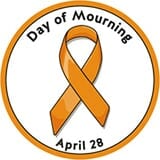
Yes, it sure appears like Google has disrespected the fallen workers of Canada. Yet it even goes deeper. So deep the highest government in Canada and our own Prime Minister proved his complete lack of respect for the Blue Collar Worker of Canada who paid the ultimate price for the occupation they worked in.
Mark Carney, the new leader of the Liberal Party of Canada, called for the 45th General Election on April 28th, 2025. Right on the same day use for the National Day of Mourning. Can there be a more disrespectful act then that. Not just for our Blue Collar Workers, but all Canadians who worked and died on the job or because of their job. Ever ask yourself what would have happened if he called an election on November 11th, 2025.
 Remembrance Day, symbolized with a poppy and a day of respect and honor. Every year on November 11th, we give respect and thanks to our servicemen and women who fought and died for our freedom. YES, they deserve every bit of that and more for suffering the ultimate sacrifice. Since 1900 through to this year 2025, more than 118,000 Canadian service members have died in wars and peacekeeping missions around the world.
From the Boer War in South African that ended in 1902, both World War I (1914–1918) and World War II (1939–1945), The Korean War (1950–1953), as well as peacekeeping including Afghanistan, their sacrifice reminds us that safety, freedom, and responsibility are never free.
Saying this from every ounce of my being and with all due respect. Why aren’t the lives of workers celebrated with just as much honor? After all, in the same timeframe between Soldiers and Workers, the fatality rate of the working class is a staggering 204.64% larger. Yet all those dearly departed workers receive is a sicker that nobody associates with them, a day of mourning nobody seems to know about, maybe a 30 second blurb on the late night news and our own leader of the country calling an election making the day all about him.
Blue Collar Worker. Over 10 Million Strong and Our Forgotten Heroes.
It’s time to change that.
For the 3 5 9, 4 7 1
